

Teamsly vs. Deputy in 30 seconds
Deputy (deputy.com) is a workforce platform built around scheduling and labor-law compliance — rule-based auto-fill, mobile time clock with geofencing and facial recognition, break/overtime guardrails, and payroll exports — sold per active user at $4.50–$6/user/month. Teamsly is the all-in-one Deputy alternative: AI auto-scheduling, live GPS location tracking, on-call shifts, jobs & crew dispatch, forms, audits, recurring tasks with photo proof, training/LMS, and a fully bilingual EN/ES experience — on flat $24–$49/location/month pricing with unlimited employees and a free forever tier.
- Deputy stops at "the schedule was published, the timesheet was exported, the rule-engine was respected." Most teams need more than that.
- Teamsly keeps going through the shift, the job site, the audit, the training quiz, the on-call rotation, the geofenced clock-in, the live GPS update, and the multi-location rollup — in English or Spanish.
- Pricing: per-user vs per-location. For a 60-employee, 3-location business, Deputy Premium runs $4,320/yr while Teamsly All-In-One runs $1,764/yr — roughly 2.5× cheaper, with more features and unlimited employees.
Teamsly vs Deputy pricing — what you'll actually pay in 2026
The Teamsly vs Deputy decision almost always starts with pricing — per-user vs per-location math has a way of dominating every other feature comparison. Here's exactly what each platform charges in 2026, and what it costs at scale.
Deputy pricing (US, 2026)
Deputy is sold per active user, per month. Every employee on your roster — full-time, part-time, or seasonal — adds to your bill:
- Scheduling — $4.50/user/mo: drag-and-drop scheduling, availability, leave, rule-based auto-fill.
- Time & Attendance — $4.50/user/mo: mobile time clock, geofencing, timesheets, payroll exports.
- Premium — $6/user/mo (recommended): Scheduling + Time & Attendance bundled, plus reporting.
- Enterprise — custom pricing: SSO, advanced reporting, dedicated success manager.
Teamsly pricing (2026)
Teamsly is priced per location, per month, with unlimited employees on every paid plan and a permanent free tier:
- Free — $0: 1 location, up to 10 employees — basic scheduling, basic time tracking, availability & time-off requests, team chat. No credit card required.
- Basic — $24/location/mo: everything in Free, plus advanced team communication, advanced reporting, basic checklists/forms, and basic quizzes/lessons.
- All-In-One — $49/location/mo: everything in Basic, plus advanced (AI) scheduling, advanced time-off & PTO management, advanced cost management, advanced forms & quizzes, on-call shifts, the Jobs & crews module, and live GPS / route tracking.
Annual billing saves up to 20% on the Basic and All-In-One plans. No setup fees, no hidden costs, cancel anytime.
Real cost comparison — 60 employees, 3 locations (annual)
For a typical multi-location operator running Deputy Premium vs Teamsly All-In-One, here's exactly what year one looks like at full price:
Key differences at a glance
Both Teamsly and Deputy publish schedules and run a mobile time clock. The split shows up everywhere else — what the platform does during the shift, what it does between locations, and how it bills you for it.
What's actually inside each platform
What is Deputy?
Deputy is a workforce-management platform founded in 2008 in Sydney, Australia by Steve Shelley and Ashik Ahmed. It is widely used in hospitality, retail, healthcare, and service businesses, and its sweet spot is keeping shifts staffed correctly while staying on the right side of break, overtime, and predictive-scheduling rules.
Deputy does a few things genuinely well:
- Drag-and-drop schedule builder with availability and rule-based auto-fill.
- Mobile time clock with geo-fenced clock-in and facial recognition.
- Strong break, overtime, and labor-law guardrails (rules engine).
- Timesheet exports and payroll integrations (Gusto, ADP, QuickBooks, Xero).
- Newsfeed for shift announcements and confirmations.
Where Deputy starts to feel thin is when you want to manage what happens during the shift — the audits, the checklists, the recurring tasks, the training, the on-call coverage, the job-level work — instead of just who's clocked in. Deputy is also priced per active user per month, so every hire (including seasonal and part-time staff) raises your bill.
What is Teamsly?
Teamsly is a complete workforce platform built for shift-based and field-based teams across hospitality, healthcare, retail, fitness, cleaning, security, construction, and field services. It bundles scheduling, time clock, communication, forms, tasks, training, live location tracking, on-call shifts, and a full crew/job scheduling module into one app — so the schedule, the shift, and the work itself all live in the same place.
The short version
Deputy ends when the schedule is published and the timesheet is exported. Teamsly keeps going — through the shift, the job, the checklist, the audit, the training quiz, the geofenced clock-in, the live GPS update, the on-call call-up, and the multi-location rollup.
Teamsly's biggest differentiators against Deputy:
- AI auto-scheduling that builds compliant schedules from demand, roles, and availability in seconds — not just rule-based auto-fill.
- Forms, audits and checklists with photo evidence and signatures (Deputy has none of this natively).
- A real task manager with recurring tasks, photo proof, and accountability.
- Quizzes, courses and training with AI-generated content from your own documents.
- Bilingual (English and Spanish) manager and employee experience out of the box.
- Live GPS location tracking on active shifts, geofenced clock-ins, and automated route history.
- On-call shifts for healthcare, IT, and emergency-response teams.
- Jobs & crew scheduling for field service operations — customer details, addresses, and dispatch in one hub.
- Per-location pricing with unlimited employees on paid plans.
Scheduling: AI auto-scheduling vs. rule-based auto-fill
Both apps let you build schedules with drag-and-drop, copy a week forward, save templates, and publish to mobile. The difference shows up in who does the work.
Deputy scheduling
Deputy is fundamentally a rules-based scheduler. You configure availability, roles, certifications, and labor-law guardrails, and Deputy's auto-fill suggests assignments based on those rules. It's reliable and structured — but every week, you're still tweaking, swapping, and resolving conflicts by hand. There is no generative AI scheduling in Deputy.
Teamsly scheduling
Teamsly does the same drag-and-drop building, but layers a true AI auto-scheduler on top that takes your forecast, role requirements, certifications, and availability and produces a compliant draft in seconds. Managers tweak instead of build.
How AI auto-scheduling works in Teamsly
- Set your demand targets. Tell Teamsly how many staff you need per role, per shift window — or let it learn from historical traffic over time.
- Availability is pulled automatically. Employee availability, time-off requests, and certification requirements are already in the system — no spreadsheet needed.
- AI generates a compliant draft. The scheduler fills every shift, avoids overtime, respects predictive scheduling rules, and flags conflicts before they become problems.
- Managers review and publish. Tweak any shift with a drag, then publish. Staff get notified instantly on mobile in English or Spanish with their confirmed schedule.
- Open shifts fill themselves. Any remaining gaps are broadcast to qualified staff with optional incentives — Teamsly tracks who accepted, who declined, and why.
Teamsly also handles things Deputy doesn't:
- Multi-schedule management — different schedules per role, department, or location, viewed in one place.
- Cross-location coverage — pull qualified staff from one location to another without manual juggling.
- On-call shift types — for healthcare, IT, and emergency-response teams that Deputy can't model cleanly.
- Open-shift incentives — automatically offer a bonus or higher pay rate to fill last-minute gaps.
Live location tracking, geofencing & on-call shifts
Both apps offer a mobile time clock and geofenced clock-ins. Deputy's clock is solid — geofencing, facial-recognition kiosk mode, and break attestation are all there and reliable.
Where Teamsly pulls ahead is what happens after the punch — and what happens for teams that don't work behind a counter.
Geofenced clock-ins & facial recognition only get you so far. Teamsly adds a live GPS dashboard, automated route tracking, on-call shift rotations, job-site geofences, multi-location reassignment, and bilingual on-shift notifications — all native, all included.
Live GPS location monitoring
- Smart geo-fencing — limit mobile clock-ins to a specific radius around an address to ensure employees are physically on-site before their shift starts.
- Real-time location dashboard — view active users on a live manager map during working hours to coordinate tasks and respond to field updates instantly.
- Automated route tracking — track the exact path your team takes throughout the workday to optimize travel time, verify site visits, and improve operational efficiency.
Deputy has none of this. Its location capability stops at "you must be inside the geofence to clock in" (with optional facial recognition).
On-call shifts
Teamsly natively models on-call shifts — critical for healthcare, IT, security, emergency response and any team that runs 24/7 coverage. Managers can build on-call rotations, send one-tap call-up notifications when coverage is needed, track who accepted/declined/didn't respond, and pay accurately. Deputy has no native on-call shift type.
Jobs & crew scheduling for field service teams
If your team works in the field — construction, cleaning, HVAC, landscaping, IT services, mobile health, security — scheduling isn't just about a roster. It's about jobs, customer addresses, equipment, crews, and dispatch.
Deputy has no dedicated job or crew scheduling module. You'd have to fake it with shift names and notes.
Teamsly includes a full crew & job scheduling hub:
- Complete job profiles — store customer details, addresses, equipment needs and clear crew notes for each work order in one place.
- Role-based crew assignments — assign the right mix of roles to each job and avoid double-booking.
- Geofenced job-site time clock — link each job to a real-world location; crews can only clock in on-site, making time, attendance and payroll more accurate.
- Live schedule intelligence — see coverage by role at a glance, catch conflicts early, and spread work to control overtime.
- Mobile job management — review jobs, edit times, addresses, notes and send shift alerts from your phone in the office or in the field.
Combined with live location tracking, this turns Teamsly into a real field-service platform — something Deputy simply doesn't try to be.
Operations, forms, audits & recurring tasks — Teamsly's biggest gap on Deputy
This is the section where the two products genuinely diverge.
Deputy doesn't really do operations. There is no native forms engine, no audit-trail builder, and tasks are limited to lightweight Newsfeed announcements and shift tasks. If you want to run a daily safety audit, a temperature log, a weekly inventory count, an opening checklist, an SOP signoff, or onboard a new hire with a quiz, you need a separate tool. That usually means Jotform or Google Forms for compliance, plus a separate LMS like TalentLMS or Trainual for training, plus Deputy for scheduling.
Most teams switching from Deputy retire Deputy plus a separate forms tool (Jotform / Google Forms), an LMS (Trainual / TalentLMS / Lessonly), and a recurring-task app — replaced by one Teamsly account at a single per-location price.
Teamsly does all of it natively:
- Forms & audits — build any form (drag-and-drop or AI-generated), assign to roles, require photos and signatures, and review responses with auto-scoring.
- Recurring tasks — daily, weekly, or per-shift, with photo proof and overdue alerts.
- Quizzes and courses — assign training, track completion, and generate quiz questions with AI from your own documents.
- Shift checklists — opening, closing, mid-shift — that an employee has to complete before clocking out.
"We replaced Deputy, Jotform, and a separate LMS with Teamsly. Three tools, one bill, and our managers actually use it across all five locations."
Training, HR & communication
Deputy ships a Newsfeed for shift announcements and confirmations — useful, but not a full operations or training system. Teamsly bundles a full HR-and-communication layer alongside scheduling.
What managers see in the first 90 days after switching from Deputy
Teamsly's HR and communication layer (chat, news feed, training, document acknowledgments, PTO) replaces Deputy's Newsfeed and the bolt-on tools teams use alongside it — all in one bilingual platform at flat per-location pricing.
Teamsly's HR and communication layer:
- Team chat & channels — per-location, per-role, or per-job, in English or Spanish.
- News feed — managers post updates, employees acknowledge, everyone stays aligned.
- Quizzes & courses — track who completed which training and when.
- Document acknowledgments — SOPs, handbooks, safety policies signed digitally.
- PTO & time-off requests — approve from the same place you build the schedule.
Bilingual end-to-end (not just translated buttons)
If even part of your team prefers Spanish, this matters more than people realize. Deputy offers partial localization but not a fully bilingual employee experience — manager dashboards and many in-app surfaces remain English-first.
Teamsly is fully available in both English and Spanish. Employees switch languages instantly from any screen — schedules, push notifications, training quizzes, forms, audits, chat, and clock-in prompts all render in their preferred language. Managers see one consistent dashboard while every employee sees the app in the language they actually work in.

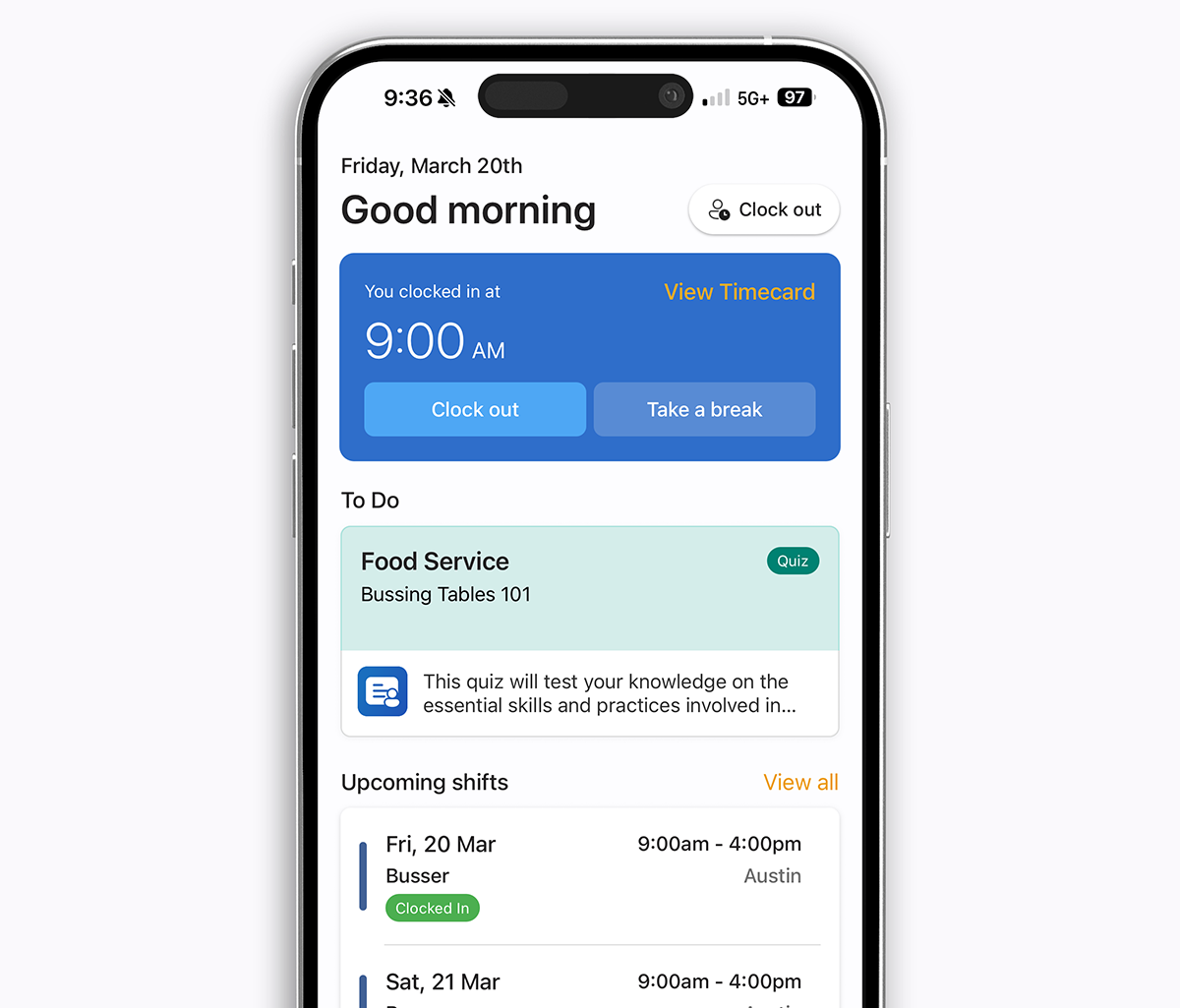
For restaurants, hospitality, healthcare, construction, cleaning and beauty operators with bilingual staff, this single feature dramatically reduces missed shifts, blown training, and compliance gaps.
Industry fit — who picks Teamsly over Deputy
Deputy's strongest fit is compliance-heavy, fixed-location environments — restaurants, retail chains, urgent care, and franchise hospitality where labor-law automation is the headline pain. If that is your only requirement, Deputy works.
Teamsly is the better fit anywhere those constraints don't apply on their own:
- Multi-location restaurants & cafes — AI scheduling, opening/closing audits, recurring tasks, bilingual training.
- Healthcare & senior living — on-call rotations, certification tracking, signed compliance forms, bilingual notifications.
- Cleaning, security & janitorial — live GPS, route tracking, geofenced job-site clock-ins, jobs & crew dispatch.
- Construction & landscaping — jobs module, crew assignments, mobile dispatch, bilingual EN/ES.
- Fitness & wellness — class scheduling, instructor swaps, recurring opening checklists.
- Field services & HVAC — jobs, on-call rotations, route history, geofenced time clock, customer addresses.
Forms, audits, training, on-call, jobs, and live GPS are all included at $49/location/month — never an upsell, never a separate seat charge. Deputy's scheduling+time tier costs more per user, with none of these features available at any tier.
Where Deputy hits a ceiling
Most teams don't replace Deputy because Deputy is bad at scheduling — they replace it because Deputy only does scheduling and compliance. The wall usually shows up in one of these moments:
- You open a second or third location and the per-user bill suddenly hurts.
- You hire a Spanish-speaking team and Deputy's partial localization isn't enough.
- You need to run a daily audit (temperature log, opening checklist, safety walk) and there's no native forms engine.
- You need on-call coverage for healthcare, IT, or emergency response — and Deputy can't model it.
- You start dispatching crews to job sites and Deputy has no Jobs module.
- You want to train new hires with quizzes and SOP acknowledgments — Deputy has no LMS.
- You need live GPS on active shifts, not just a clock-in geofence.
Deputy's tiers add reporting, SSO, and dedicated support — they never add the operational features above. That's the ceiling.
Real-world scenarios
A small team getting started
If you just need a simple way to create schedules and message your team, Teamsly's Free plan can get you going (1 location, up to 10 employees) with no credit card. Deputy offers a 31-day free trial but no permanent free tier — after the trial, you're billed per user.
A team starting to feel disorganized
As your team grows, things that used to be simple start to break down. Tasks get missed, communication happens in too many places, and new hires aren't trained the same way — leading to inconsistent performance. At that point, scheduling alone isn't the problem — it's everything happening around the schedule. That's where Teamsly starts to add real value.
A growing business with multiple locations
Once you're managing multiple teams, the challenge isn't just scheduling — it's consistency. Teamsly helps standardize operations, training and workflows across every location, with one dashboard and per-location pricing that's predictable as you grow. Deputy's per-user model gets more expensive every time you hire — and you still don't have forms, training, or jobs.
A field service or multi-site operations team
If your team works across customer sites or moves between locations, Deputy falls short. Teamsly's jobs & crew scheduling, geofenced job-site clock-ins, live GPS tracking and route history are purpose-built for this work.
A team using too many tools
Many businesses end up using Deputy for scheduling, Slack or WhatsApp for communication, Jotform for compliance, and a separate LMS for training. That setup works at first, but over time it creates friction and slows everything down. Teamsly solves this by bringing everything into one place.
Pros and considerations
Deputy
Pros
- Strong rule-based compliance & labor-law engine
- Reliable, structured scheduling tools
- Polished mobile time clock with facial recognition
- Solid payroll integrations (Gusto, ADP, QuickBooks, Xero)
Considerations
- No forms, audits, training, or LMS
- No true AI scheduling — only rules-based auto-fill
- No live GPS dashboard, on-call shifts, or jobs module
- Partial Spanish localization, not fully bilingual
- Per-user pricing climbs with every hire (incl. seasonal)
- No permanent free tier — 31-day trial only
Teamsly
Pros
- One app for schedule, shift, and operations
- AI scheduling, AI forms, AI quizzes
- Live GPS, geofenced clock-ins, route tracking, on-call
- Full crew & job scheduling for field teams
- Fully bilingual English/Spanish end-to-end
- Flat per-location pricing — unlimited employees
- Free forever plan (1 location, up to 10 employees)
Considerations
- More than a basic scheduling tool — slightly more setup
- Less focused on a pure rule-engine for compliance than Deputy
- Built-in payroll is regional
Other Deputy alternatives worth comparing
Teamsly isn't the only Deputy alternative on the market — if you're shopping around, these are the names that come up most often. We've published full head-to-head comparisons on each:
- Teamsly vs 7shifts — restaurant-only scheduling vs an all-in-one workforce platform.
- Teamsly vs BuddyPunch — per-user time-clock app vs flat per-location all-in-one.
- Teamsly vs Connecteam — module-stacked pricing vs everything-included Teamsly.
- Teamsly vs Homebase — small-business scheduling vs multi-location operations.
- Teamsly vs Humanity — legacy enterprise scheduling vs modern AI scheduling.
- Teamsly vs Sling — per-user scheduling+chat vs all-in-one EN/ES platform.
- Teamsly vs Square (Team) — POS-attached time tracking vs purpose-built workforce management.
- Teamsly vs When I Work — per-user scheduling vs flat per-location AI-first.
The bottom line
Deputy is a strong option if your single biggest pain point is labor-law compliance and rule-based scheduling for a fixed-location, English-first team — that's what it was built to do, and it does it well.
Teamsly is a better fit for businesses that want to go beyond scheduling and run their operations more efficiently in one place. If you're focused on AI scheduling, on-call coverage, field jobs, forms and audits, training, bilingual EN/ES support, multi-location consistency, or simply not paying per user every time you hire — Teamsly tends to deliver more long-term value, and at flat per-location pricing it usually costs less, too.
Pure scheduling + a strong rules-based labor-law engine for a fixed-location, English-first team. You're comfortable paying $4.50–$6 per user per month forever and bolting on separate tools for forms, training, on-call, and jobs.
An all-in-one workforce platform — AI auto-scheduling, live GPS, on-call, jobs & crews, forms, audits, recurring tasks, training, bilingual EN/ES — on flat $24–$49/location/month with unlimited employees, no add-on fees, and a permanent free tier.
Try Teamsly free
Teamsly is free to start, with no credit card. Most teams have their first AI-generated schedule built in under 10 minutes. Start your free Teamsly account →